
From Classroom to Nature Trail: How Jennifer Blay Brings Science to Life
Jennifer Blay
Middle Level Science Teacher, Lowell Graded School
North Country Supervisory Union Vermont
What a pleasure it was to spend a November afternoon at the Lowell Graded School with Middle School Science Teacher Jennifer Blay and the eighth-grade students! To say that they were engaged, wheels turning, respectful of one another, and really enjoying the process is an understatement. Jen Blay is a focused teacher leader, who cares deeply about her students. Vibrant, intelligent, kind, and versatile, her depth of knowledge in multiple disciplines and her deep grasp of how students learn are striking.
An exemplary educator. With six Vermont Educator Endorsements, she is a school leader’s dream. She holds two administrator licenses - principal and curriculum coordinator - and is certified and has served as interventionist, preschool teacher, reading teacher, and middle level science teacher. Jen also has 20 years teaching experience over a longer period, having taken leaves when her own kids were young.
Clear path to a career. Jen always knew she wanted to be a teacher. She grew up in the Northeast Kingdom, in Newport, went to school there in the district where she has been working for more than 14 years. She loved her teachers and wanted to be just like them.
“When I was at school, I guess it was just a place where I felt I could accomplish things, do what was asked of me. I always liked teacher approval, and those teachers were good at building connections. I just wanted to be at school every day and they were just some of the best people. I looked up to them and knew I wanted to be a teacher when I grew up. Teachers would give away the old textbooks, and I would bring them home. I have two younger sisters who then started getting spelling lessons. I would grade their spelling tests with the answers. We did that for fun in our free time as little kids. So, yeah, always. Never changed my mind, I just knew what I wanted to do.”
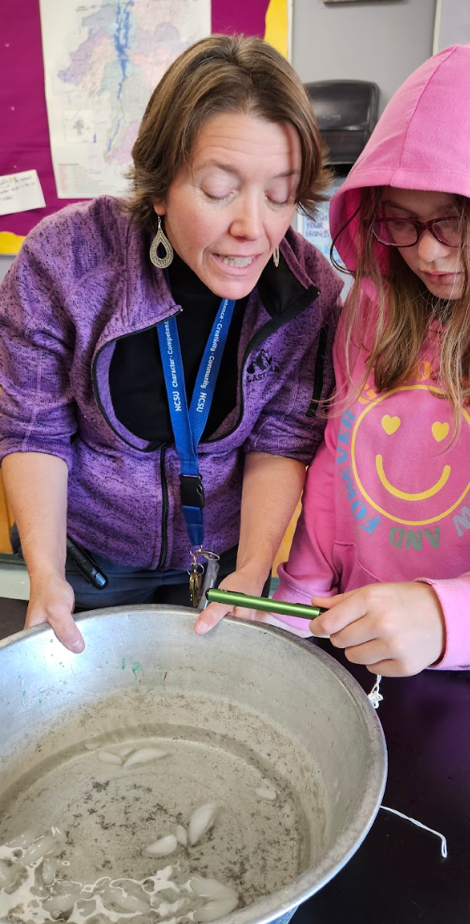
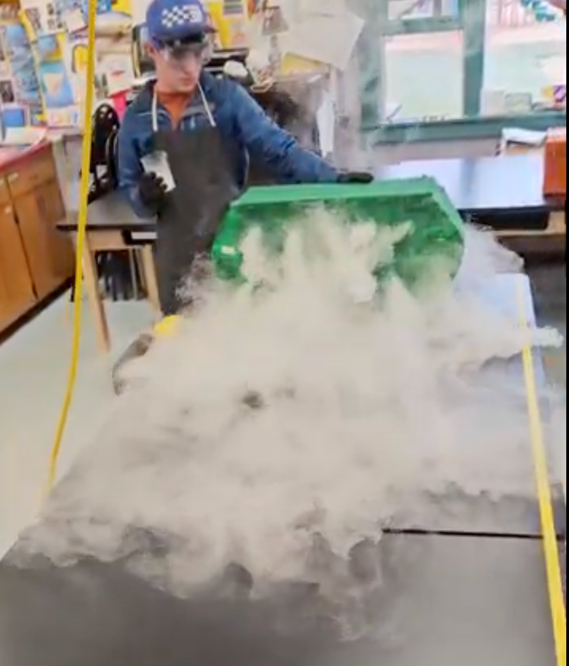
“I grew up in Newport. This is my home. My dad still lives in the house that I was born and raised in, so yeah, my roots are deep here. It was the educators in this district and this community who inspired me. Many of them now have retired, but it was great that I had the privilege to work with them. I've been in the district, I think, 16 years. So, I got to work with some of my mentors and idols, people that I really cared about. That's cool!”
A lifelong resident of the Northeast Kingdom, Jen graduated from Lyndon State College (now Vermont State University) for both undergraduate and graduate studies. While deeply interested in both district-wide curriculum development and individualized student learning, she has chosen to remain in the classroom, teaching various subjects including literacy and science, preferring the direct work with individuals and small groups of students.
Passionate about working closely with students. She shared her perspectives on the meta, and micro views of learning and perches for teaching. Interested in both the wider, systems view and direct work with students, she much prefers the latter. She is intrigued by district-wide learning, coordinating the curriculum, engaging professionals in that development, understanding, and implementation, but has consistently chosen the closer exploration with students, the deeper dive into how each student learns, and the luxury of following students all year, and more often in a small school, for multiple years. For about twenty years, she has chosen to work directly with students. She has changed her content - literacy, intervention, preschool, and now science.
As Jen was introducing a new unit in science, her instructions to the eighth graders were transparent, metacognitive, all in preparation for high school. She provided direction, talked openly to the students about why she was doing what she was doing– and what they would be doing, and why, and explaining the nature of a different set of responsibilities and learning opportunities to come.
“That's probably at the heart of how I choose to teach, which is to help them learn how to learn, become owners of their own learning. I use “Leaders of Their Own Learning”, a book by Ron Berger. I reference it a lot because I think that students, once they know how to learn, can learn anything. And so, it's more providing the skills to learn than just knowledge. I love doing hands-on projects, but I also think kids (being a former reading teacher) really need to know how to read texts and use a textbook. They need that exposure and they need to know how to find important information, how to think about it, how to be actively reading. Thinking, am I engaged with this text? Am I just writing it down? Am I thinking about what it means?”
While she feels she hasn’t quite mastered everything, she understands on some level, that one never does. She was candid in sharing one additional personal reason she has stayed in the classroom. She is a devoted mother of two children, and putting family first was a priority. Her teacher’s schedule allowed her to be with her children on breaks and summers, to attend their games and functions. That was a high priority for Jen. Now that her own children are in college, she may at some point venture out into that broader, more systemic arena of leadership or administration, though “not yet”.
“I think of the jobs I've had in life, being a mom is one of the top ones. And so being a teacher allows you to… go to their games, to be able to be there, there on the vacations to be present. So, I think that's a gift and I think that a great part of the education piece is being able to be a present parent, because not everybody gets that same gift. With many jobs, you're working late nights or weekends. Both of my sisters have had jobs where that's the case. I love teaching, but time is the bonus! I think a lot of people don't realize the schedule is compatible with raising a family. You work hard when you work, and then you have a little break.”
“I just love being in the classroom and working with kids. So, I guess I'll know when the timing's right to do something different, but it's not yet. so… I don't ever think I do anything special other than show up and care, right?”
Showing up and caring captures who Jen is as an educator. Impressive.
Outdoor learning! As so many of our “Rural Voices” have echoed, she would teach outside all day every day if she could make that work! She relayed the multiple strategies she employs to get students outside, to use the natural world as the venue to learn, particularly science.
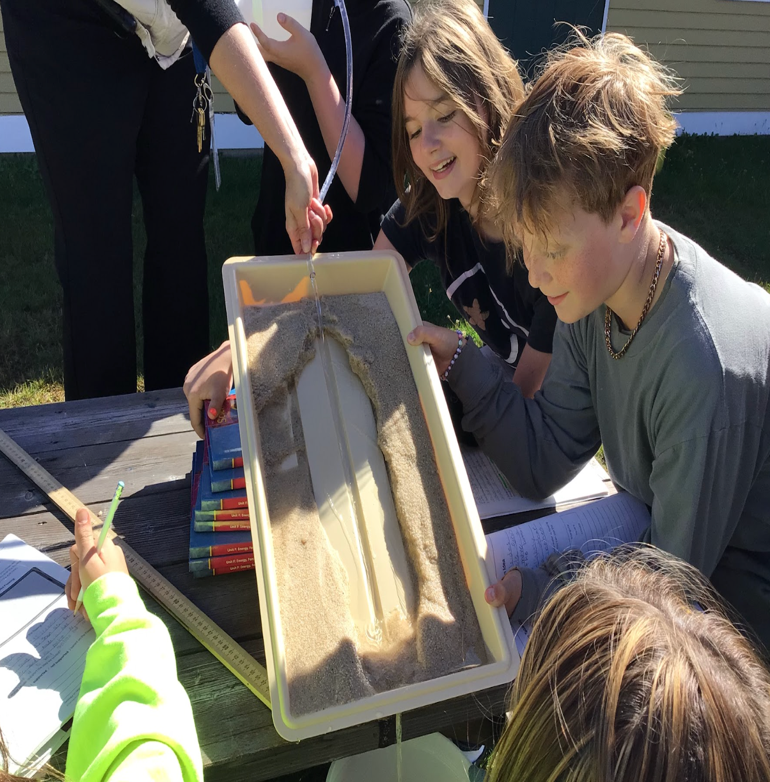
“I do love the outdoors. That's one of the things I'm the most passionate about. I think students should develop a love for being outside. I enjoy being outside. I like to hike, bike, and kayak. I've been working on the long trail with my son. Most of my time, I'd prefer to be outside than inside. I realize how important that is and how many kids don't tend to go outside anymore. We start the school year and usually end it being on the nature trail, and the reason we start and end it that way is because I find kids are more engaged. And we have a nature trail that that the students have worked on.”
“We do a lot with birding and identifying birds using the Merlin app. And then we look at plants and insects, identify them. …We have game cameras, so the students went out, and they did their own observations. We went for trips, and we pulled the game cameras in; we pulled all the information off them. We need to put the game cameras back out. So, we do the game camera piece, and the students all learned about this habitat together, and then I had them research a habitat somewhere else so they could learn about a different part of the world. What we were really learning is that things are not really a food chain, but a food web. The reason why is that everything is interdependent on everything else. And so, they learned a lot about limiting factors and carrying capacity, and I think what they took away is - whatever we do matters. Everything impacts something.”
Jen offered multiple other examples of drawing upon streams, rivers, habitats, fish, …hands on, student led, real world learning outdoors. She offered several examples of how she facilitates bringing science to life, experiments with real world problems and challenges to resolve, such as exploring chicken meat to learn about ligaments, tendons, bones, tissue, and more.
She described both the content and the processes of her students working to plan and apply for a VREC mini grant.
“And then we do VREC mini grants. Right now, seventh grade is almost done writing their grant. They decided this year that they wanted to do a bread/pizza oven. I had my own hopes and dreams for what I wanted to do for a VREC project. However, I think it's super important that the kids want to do the work and that it's their idea. And they said, we want a pizza oven. So …we want to eat, we want it for fundraisers, we can use it for community events. So, they're almost done writing the grant. And they said, this is hard, this is as hard as science fair! (We do Science Fare in January and February.) I said, oh, you must think and think deeply. "But do you think it'll be fun when we get ready to build it, and then when we get to have it?” It's good when kids realize how hard something is. What I love about the VREC mini grants is that the kids see a light at the end, and there's a reason they're doing the hard work, and kids are driven that way. They do have to go through the process. And if they're denied, so to speak, what I like about VREC, is it’s built on a growth mindset model. So, the growth mindset is fixed, and the students can make their project proposal better. It's usually not a no forever. It's a no for now because you must make improvements. So, they are still looking for quality. They are still looking for the kids to do the hard work, but then that the hard work gets rewarded with the project. So, they're in the middle of doing the hard work, and they're realizing how hard it is. There are some slight grumblings, but again, that's why I love it."
“I wish I could teach everyday outdoors, but right now there's work we're moving into, we bounce between the book learning and hands-on inquiry because of the reading teacher in me. That's so important that they learn those skills and notetaking. And then I'm at the end of a section or two, what are we going to do with that information? I want it to become real to them, because I always think students should be able to read and write about something, but then they should also be able to have hands-on experiences to make everything come together. The more ways I teach it, the more students I reach. So, I think that's an important piece for me, too, is to always be thinking, am I reaching every child and do I need to teach it in a different way? Giving them the sort of whole circle of approaches. I think that's important because I always see different light bulbs go on for kids at different times.”
She talks about how she may not be the students’ favorite teacher; she’s not funny, or gratuitous. She is serious and wants her students to take learning seriously. She’ll take second place in the popularity contest, if she can instill in her students the rigor and the stamina of learning.
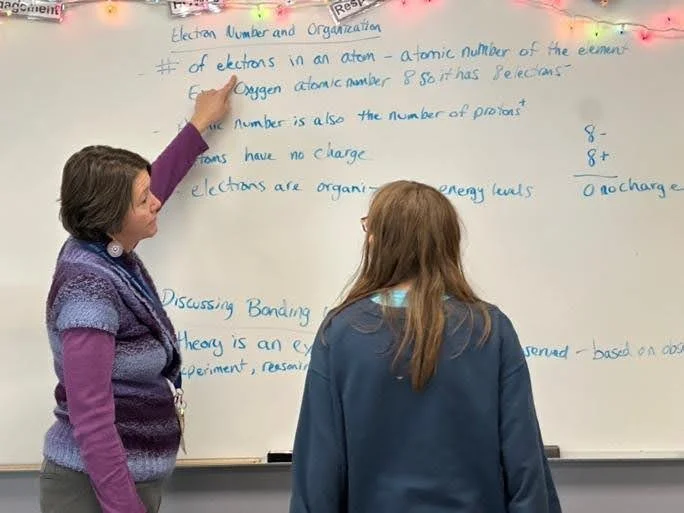
“I don't usually get referred to as their favorite teacher, but I don't get heartbroken over that. I find that my relationship with them is different, and I'm always looking and thinking deeply about how I can help them meet their next steps. I find I'm just in that moment and in that relationship building. I'm thinking about their future too much and there's so much at stake, I find I'm too serious sometimes with them, but that's OK so they know we all we all serve different roles.”
She closed with the passionate story from her daughter, who never wanted to go into education, has entered the field of study, influenced by her mother’s passion. Inspired by her mother’s deep passion and commitment, her daughter has also chosen to pursue a career in education.
“My daughter had me as a teacher her eighth grade year, and she said, "Mom, I'll tolerate your existence, because I know it's a good move for you and how much you love teaching science.” I just kind of laughed, "Okay, good, you're going tolerate my existence." It had always been my dream to be her teacher, I felt like I was being given a gift and an opportunity. And then I had my son also. He came in as a sixth grader. And so, I taught both of my children. My kids came home with me every day. My daughter always wanted to be a journalist and a writer, and she right now is going to school to be a teacher. She wants to be a middle school science teacher. I guess what makes me excited and teary eyed is the fact that… it was because she felt I made a difference every day. When she told me that, I'm like, oh, she's been listening all these years to every story I come home with. I know how much I love my job and how much I love working with the kids. Most days are great days, and I always have something fun or good to share with them. I usually am explaining to them the best parts of my day, and there are so many. And there are so few bad parts of the day. Anyway, it is a joy and a pleasure and fun. And to know my daughter wants to do it for that reason, too. Besides everything that's going on in the world… which can make a teacher very disheartened… if you stay at the heart of the matter and you keep your eye on the children and making a difference every day, then you're fine. If you start looking outside of that box, it can be either overwhelming or disheartening. So those are my insights. That’s why I think I'm sticking around.”
