
Lindsey Benton, “Stealth Undercover Art Teacher”: Integrating, Connecting, Engaging in Project Based Learning, and Building upon Themes.
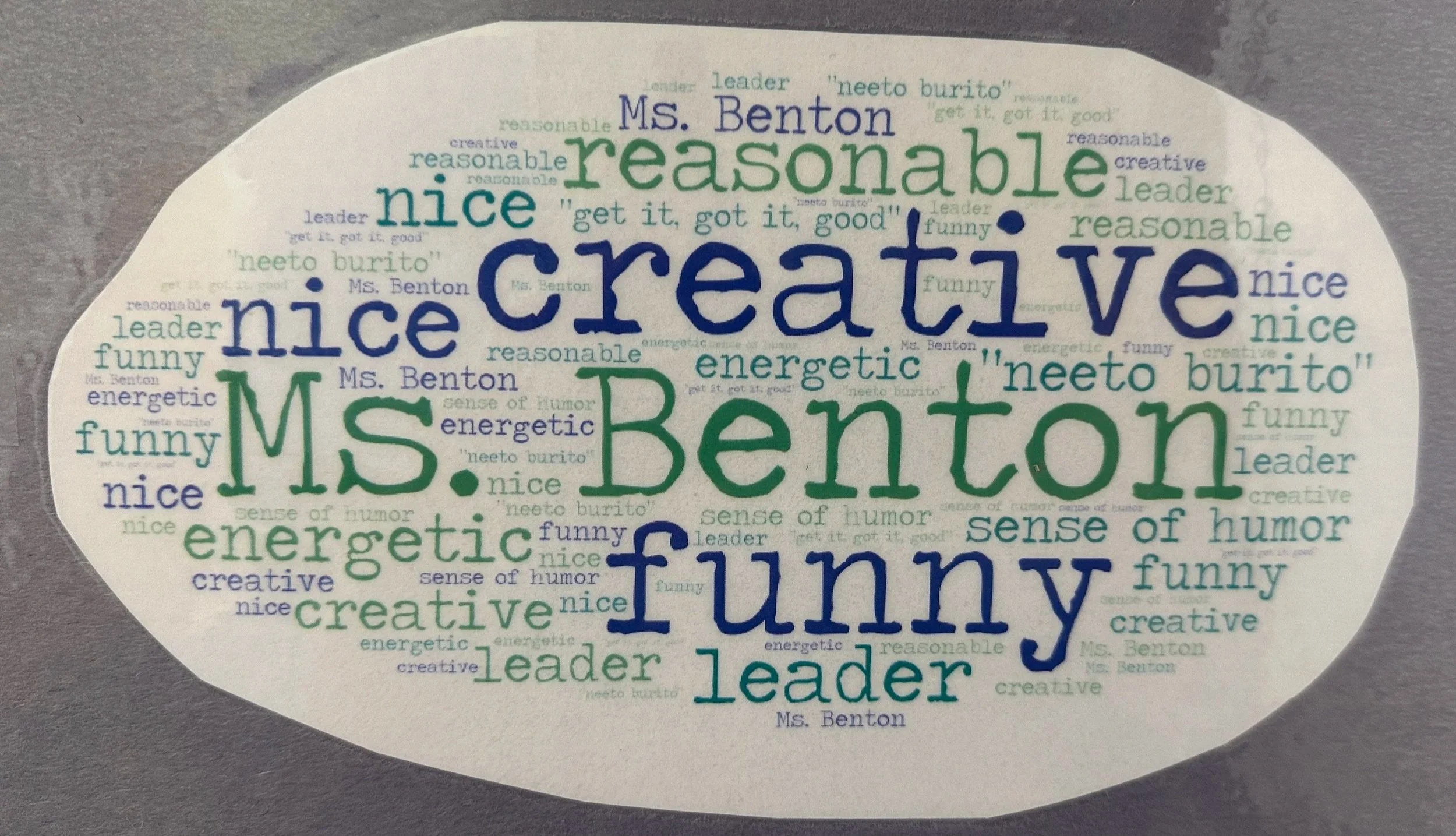
Lindsey Benton
Grade 5-6 Teacher
Woodbury Elementary School
Orleans Southwest Supervisory Union
Hardwick, Vermont
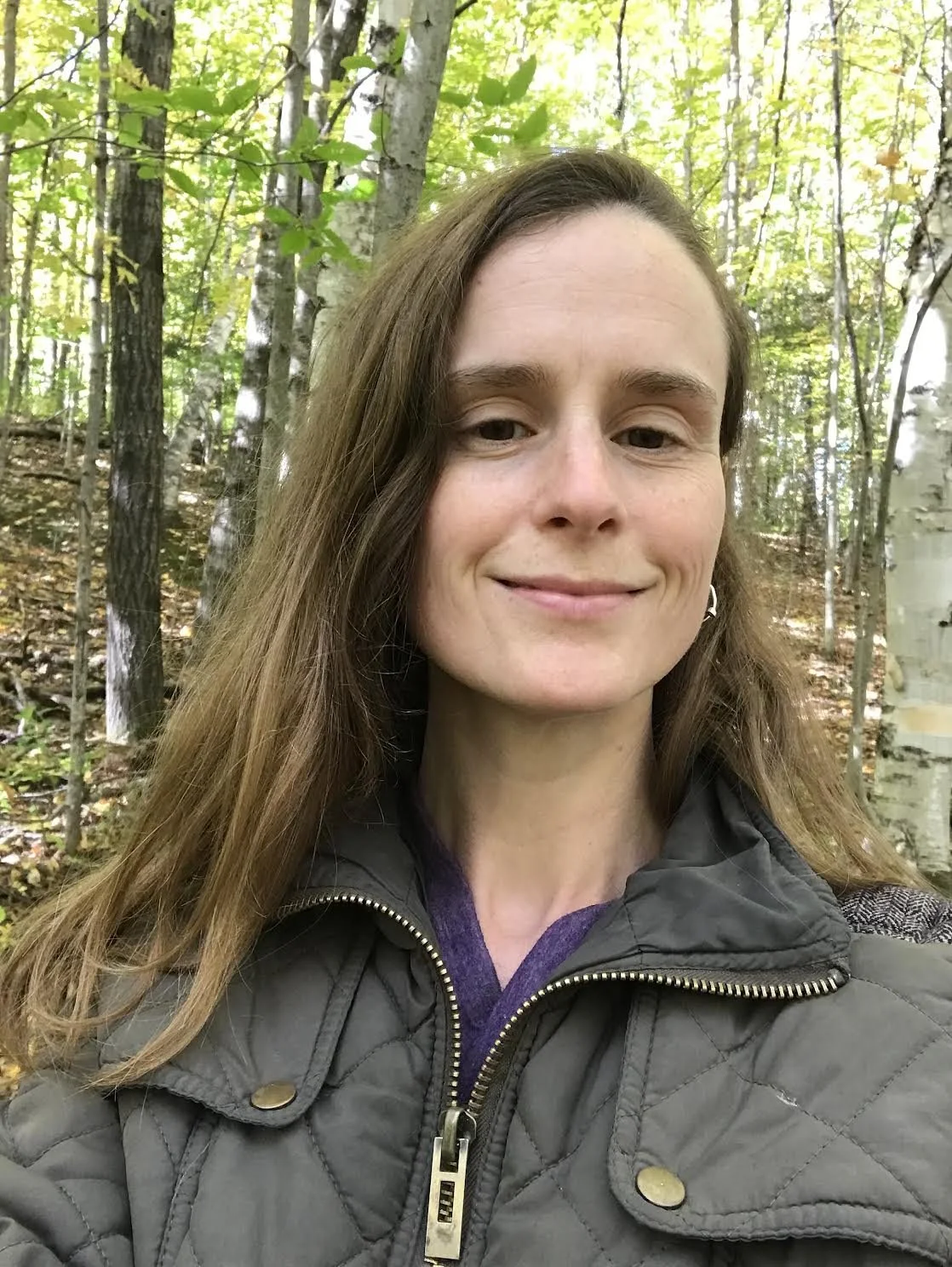
As soon as I contacted Lindsey Benton, I was confident that her "Voice" would be a strong one. Articulate, excited about teaching and learning, and enthusiastic about sharing her journey, Lindsey made time for our meeting and interview during the very last week of the school year! With 14 years of teaching under her belt, five of them at Woodbury, she exudes confidence and a masterful understanding of how a classroom should be structured for students to learn and thrive.
Lindsey grew up in Freedom, New York, a very rural area of the western part of the state and appears to appreciate rural life here in Vermont.
As is the case with many teachers, Lindsey did not set out to be an educator; rather she intended to be a biologist, a veterinarian. What enticed her to shift her thinking?
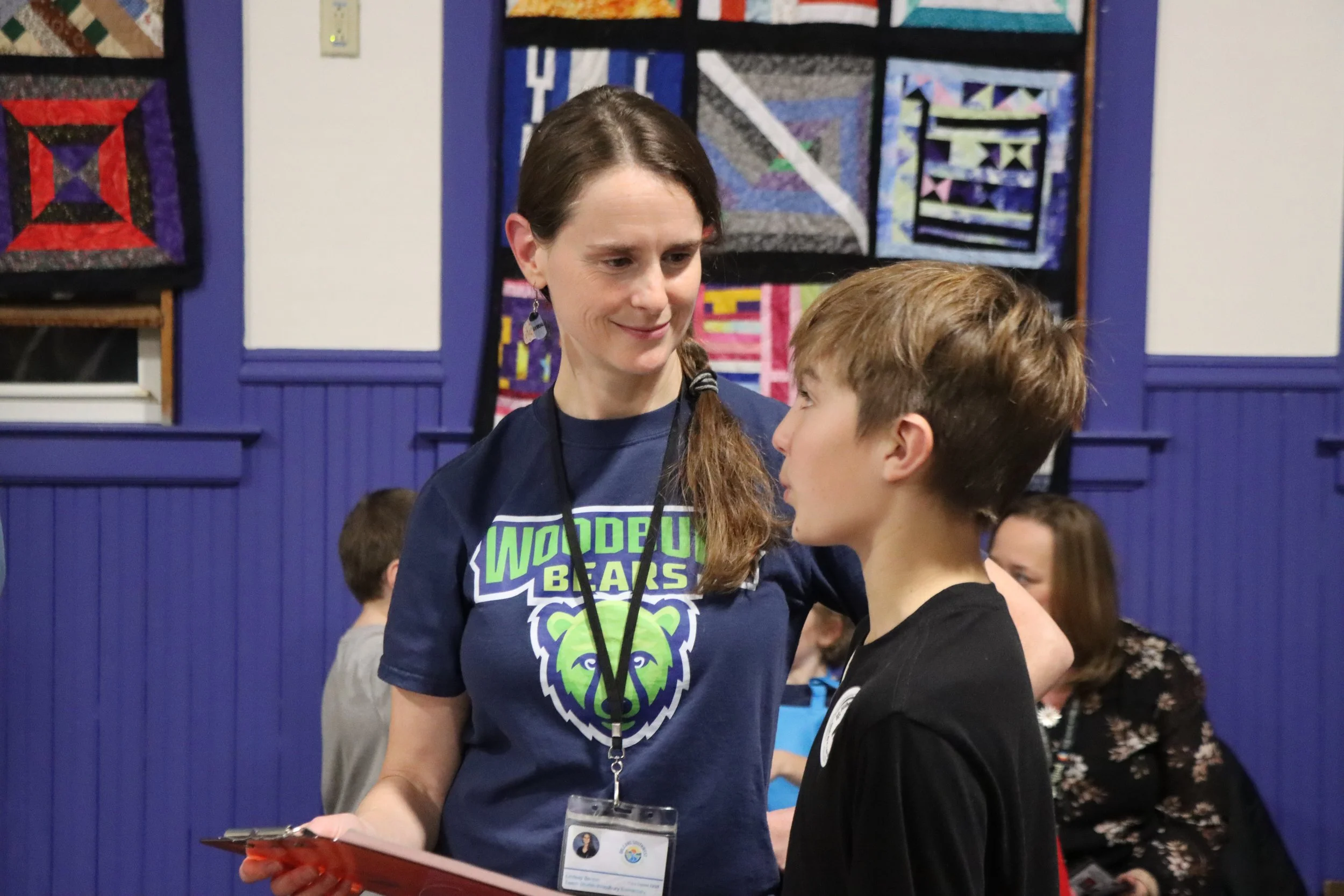
“Waldorf is all about the metaphor and what you're teaching, matching the developmental age of the kids. I just loved the meaning and the intention behind it all. I thought that I definitely had found my forever home there. I taught at Orchard Valley for 9 years before I switched to public school. I'm glad that I made the switch here because I really realized that there are tradeoffs with any one modality of education. “
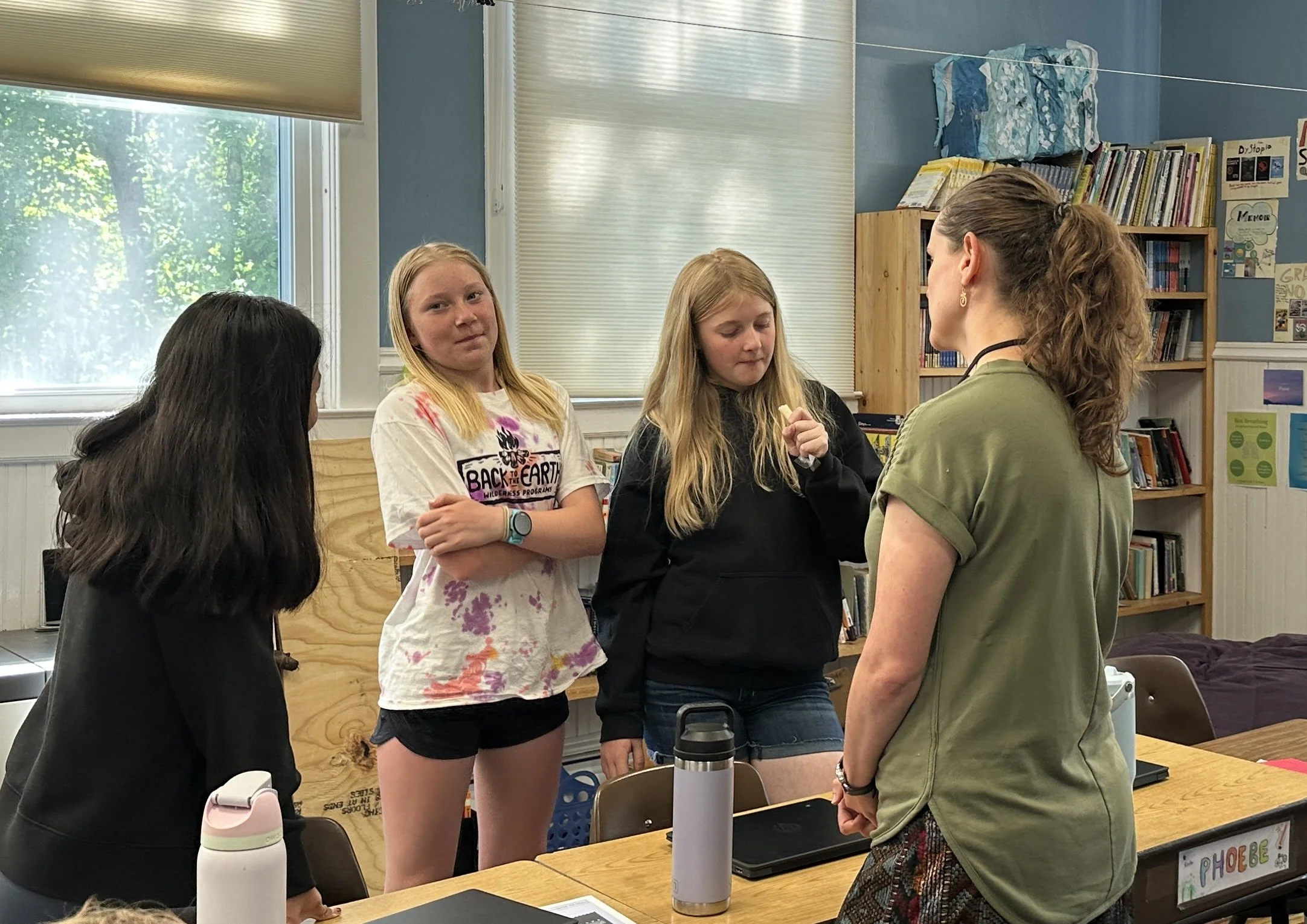
“I also learned that public schools are places where we can do projects. really appreciate the professional development offered in public schools. I've really grown as a math teacher and a reading teacher. And really a teacher of skills. ...just the way that I do explicit instruction, not that I wasn't explicit before, but having that professional development was super helpful and then realizing that, oh, you know, public schools are a place where we can do projects. I think in my mind, I had thought I can only do this kind of teaching if it's in a private school.”
“But to spread my wings and see how it can fit to public education feels really equitable to me. I'm glad that this can be available in public school. It should just be a right for everybody, not just for folks who are fortunate enough to pay for something different from public. And it's great that I'm here at a school like Woodbury. It's a really cohesive, competent group of people that like to do fun projects.“
As we began the substance of our interview, Lindsey described a major project she collaborated on with a colleague, and her excitement with it was so clear as she described its genesis and implementation.
“I've been here for five years now. Prior to working here, I worked at a Waldorf school for 9 years. I have to be honest, that does shape a lot of my approach, and what I do with education because it definitely integrates the arts in a very intentional way. It's very thematic, and that's how I love to teach. I love to have a big project that intertwines a lot of disciplines. By doing this one big picture project, we're roping in... math, where it's practically applicable, and social studies, and science, and writing, and reading. That is how I love to teach. To the extent that I can make it happen here, I do, and, I really have loved leaning into project-based learning in public school and just seeing where it can take us. “
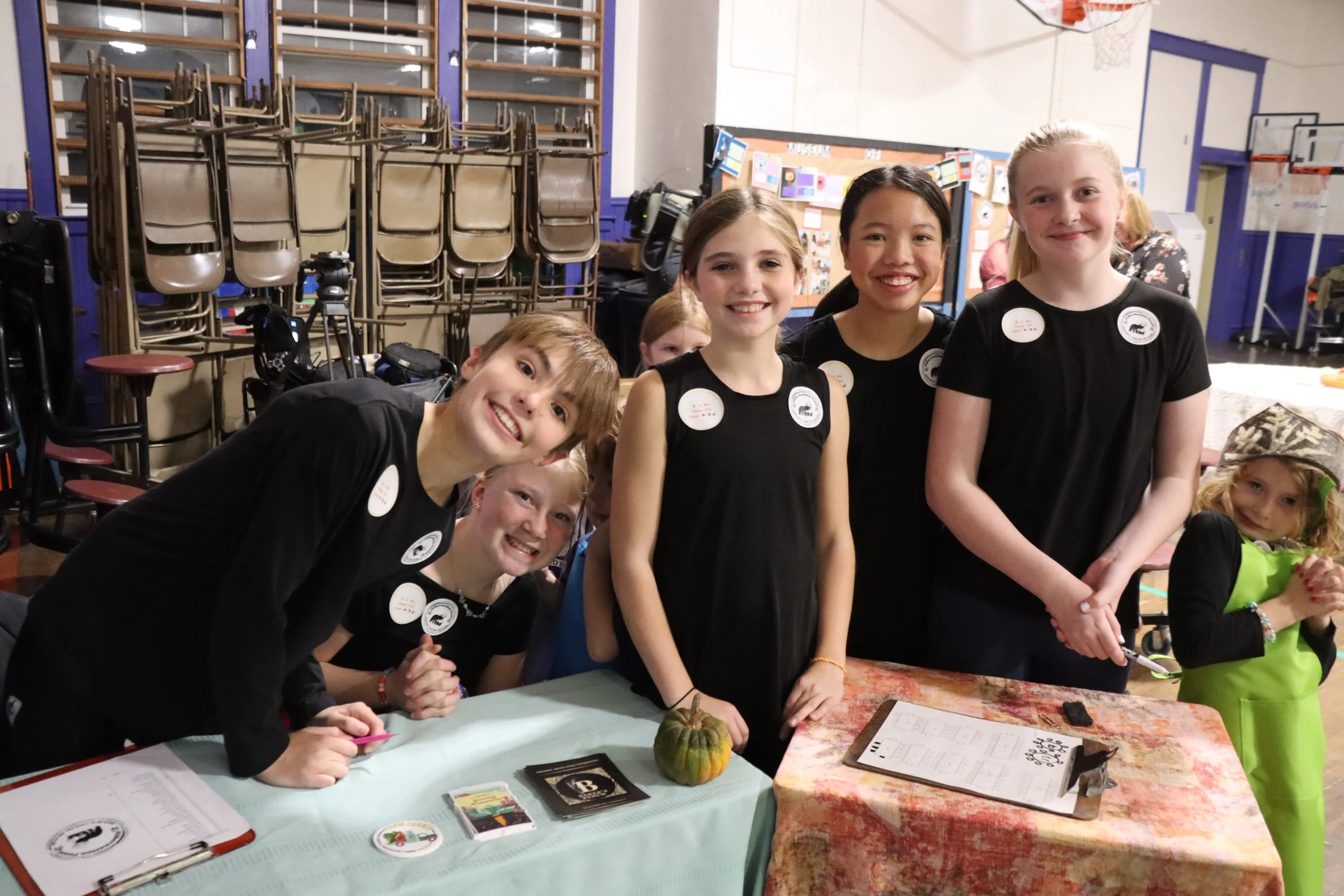
“This past fall, my colleague Cat Siefert and I, (Cat teaches K1), took on a really big project together, which I'm excited to share with you. She and I took a graduate course, last June (2025). It was through the Project Design Lab at UVM, and we spent five days really hatching a plot for this past school year now. So, I'll back up and just say that we have a tradition here at Woodbury, where the youngest class partners with the oldest class, and they're buddies to each other. It's a very sweet tradition. So, this year's 6th graders remember being kindergartners and 1st graders and looking up to their 5th and 6th grade buddies.”
“And to have it come full circle for them is so sweet and meaningful. When Cat and I were taking this graduate course together - and the whole purpose of this course was to plan a very big project for your students - we thought, huh, can we do something together? And then, I don't even know exactly when the little seed of inspiration came, but once it landed, it took on a life of its own, it was so cool. I think that we were just tossing out ideas and the idea of food came up. And then I was thinking, oh, it'd be interesting to look at food through the lens of the local economy and food economy, and how that works. I was immediately thinking, oh, I have some economic standards at 6th grade that I could cover through that, and ratios. That's a huge topic in 6th grade for math, and we would be doing that in the fall. And at was thinking about her standards too, and she was thinking - we have to do things with roles of community members, and she's thinking farm to table would work really well for that. So, we just hatched this project, and we mapped it all out, thanks to this course, which I was so glad that we took. That's how we spent the fall - really getting into that. And I think the part that was particularly inspiring to me, and really lit me up as a teacher, is that for all of these, the help just showed up! It was kind of low touch from me and Cat to some degree, just because there was such an outpouring of support for this project and just expertise that showed up at our door.”

“The school mascot is a bear. The class decided on "Hibernation Feast" for their overall idea and project, and they wanted to have a big restaurant to culminate their learning. We knew that we were learning about restaurants and food, and that we were going to have a big feast, our "Hibernation Feast".
“And then the kids learned how to use Canva, to design a logo, and they all made their own logos, and we voted on them. The winning logo is so cute. It was a mama black bear and two baby bears with chef hats. I felt like that captured so well the collaborative nature of the project because there were these beautiful ways in which K1 and 6th grade merged and came together in very sweet ways.”
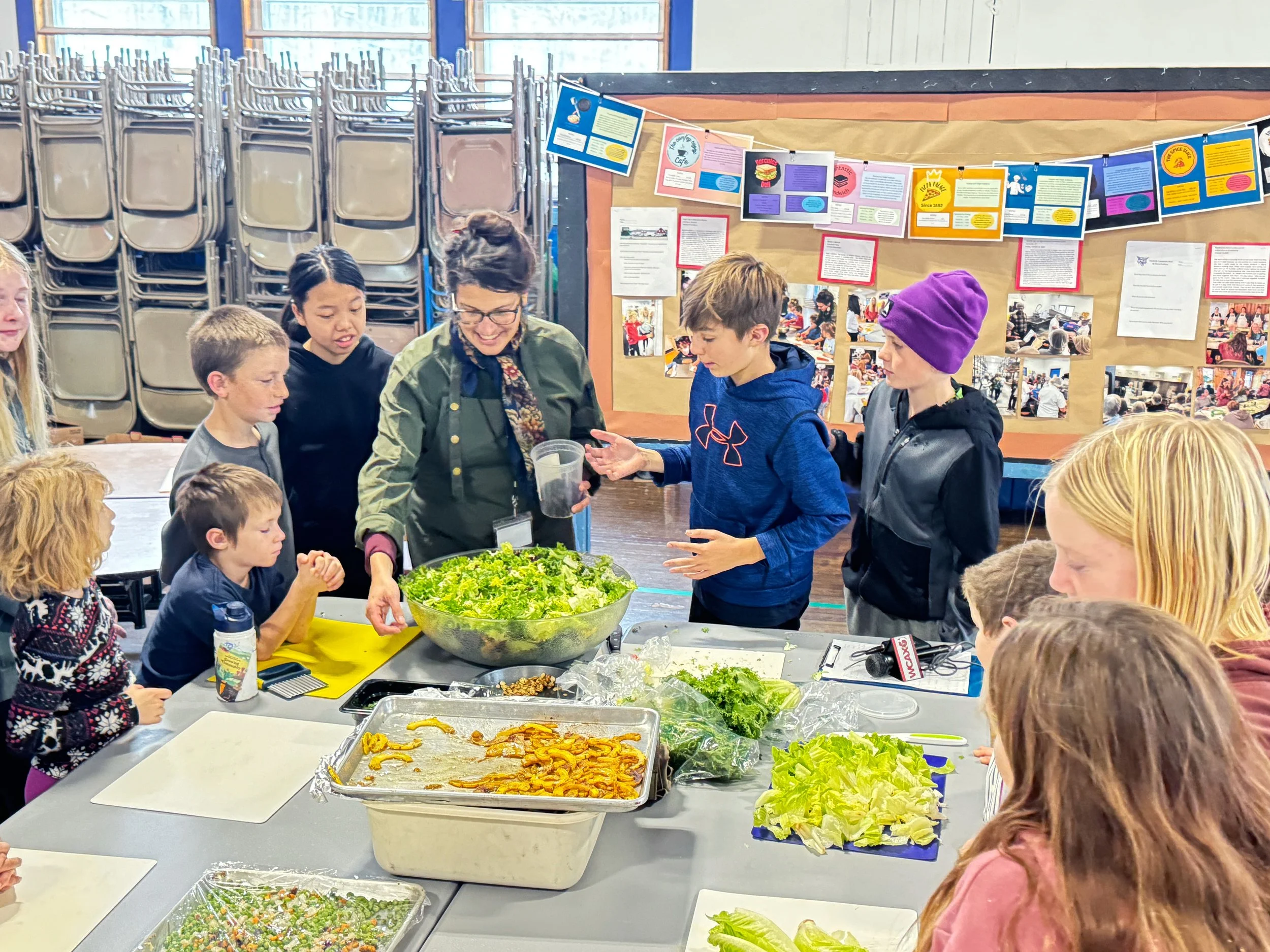
“There's the CAE, the Center for an Agricultural Economy, over in Hardwick. The 6th grade took a field trip to the CAE to see how that worked, and it was really interesting for them to hear how local farms partner with an organization like the CAE to say, have their carrots show up in hospital cafeterias or school cafeterias, and follow safety regulations and guidelines. Reeve Basom is the "Place-based Education Coordinator" there.”
“We culminated the project with a huge "Hibernation Feast", and we served over 120 people. Jasper Hill, North Hardwick Farms, and Pete's Greens all made food donations! The kids all took a role because they saw how restaurants work. They had hosts that were greeting our guests. We had servers that were figuring out where folks were going to sit... There was a lot of agency in this for them. The servers even made a little seating chart for themselves on a dry erase board, and they were keeping track of where seats were taken and who was going to go where next.”
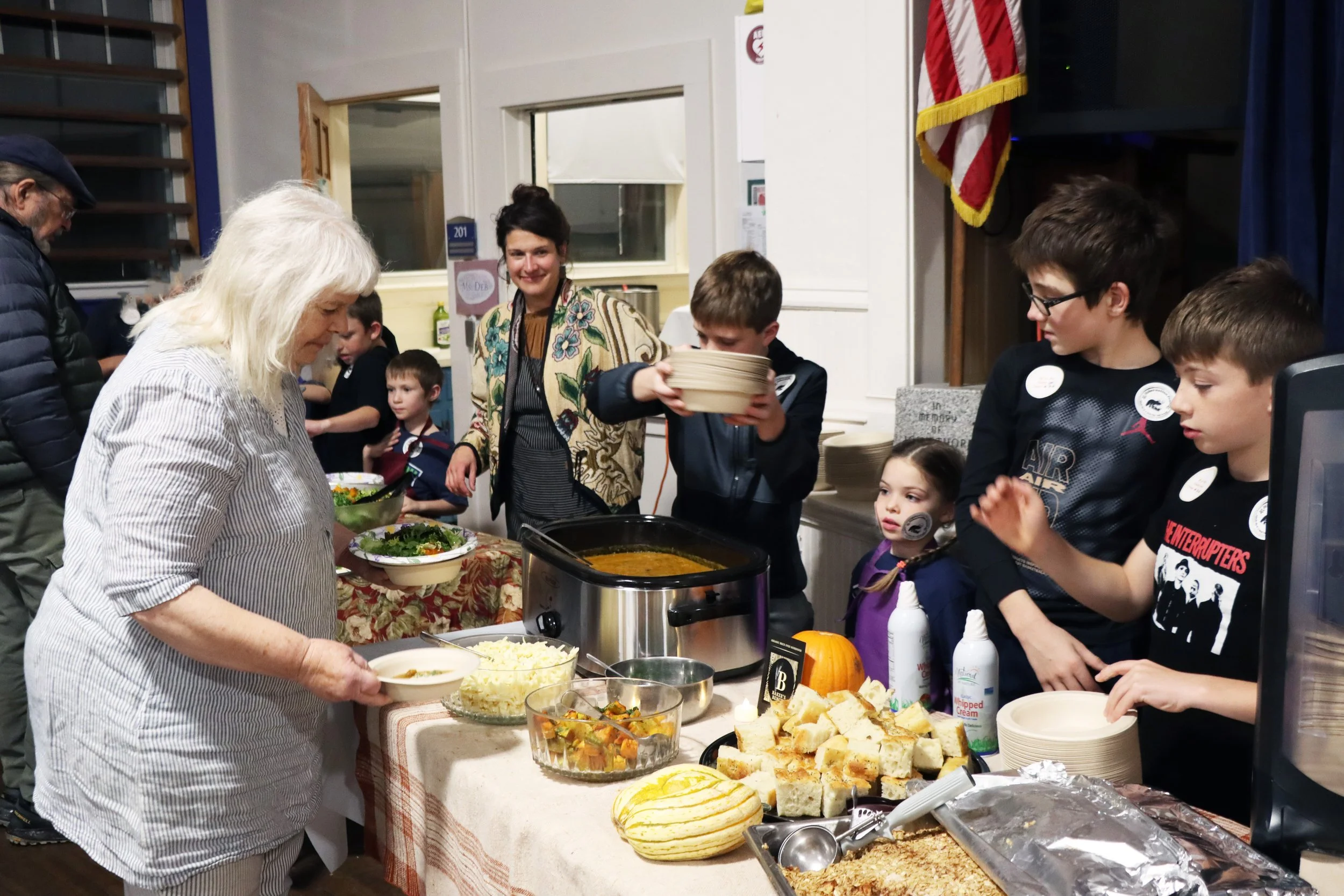
“After the Feast, the students reflected on the entire experience. We wrote a little bit about it. We did a lot of reflecting. I was very surprised to hear what they took away from the project; they were really thinking about running the restaurant, how to work under pressure, and make decisions under stress. A lot of them enjoyed the designing aspect of it. We did a lot of little mini projects that had the restaurant project as the main hub. One of those mini projects was their coming up with a menu item and they had flyers, so they could go shopping for ingredients. They had to build their sandwich, figure out its base cost and then figure out how much they were going to mark it up. They created flyers for their little menu items. Many of them really liked that process, and thinking about percentage markup. A lot of them liked working with their buddies. It touched many different areas. It was really cool. We invited our instructor, Paul Gambill, Director of the Project Design Lab, to come and hang out with us on the evening of the feast so he could see the culminating project in person. It was basically our final!”
“As you can see around my room, I'm in my comfort zone doing larger scale art pieces with kids. So, I'm fine with the paper mache and paint and all of that. But I think what this course helped both me and Cat do is really think about how can we just get the community involved and how can we be planful in the beginning? Because I also like to lean into the creative process and just see what unfolds. And this had us be more intentional about what we were doing before we got started, so that was very helpful. ...the layering of the curriculum, the offshoots, and the capacity to just go with that and let the kids kind of take it where they wanted it to go.”
“The more you look, the more you see. I just keep seeing where different things could happen. I think by the time we were done, gosh, we did like 9 different things with the restaurant project.”
We chatted about what might be next for Lindsey and Cat, and they are contemplating the many possibilities.
Lindsey is very articulate, and what she described in detail is the essence of what we want to promote with the Voice of Rural Teachers Project.
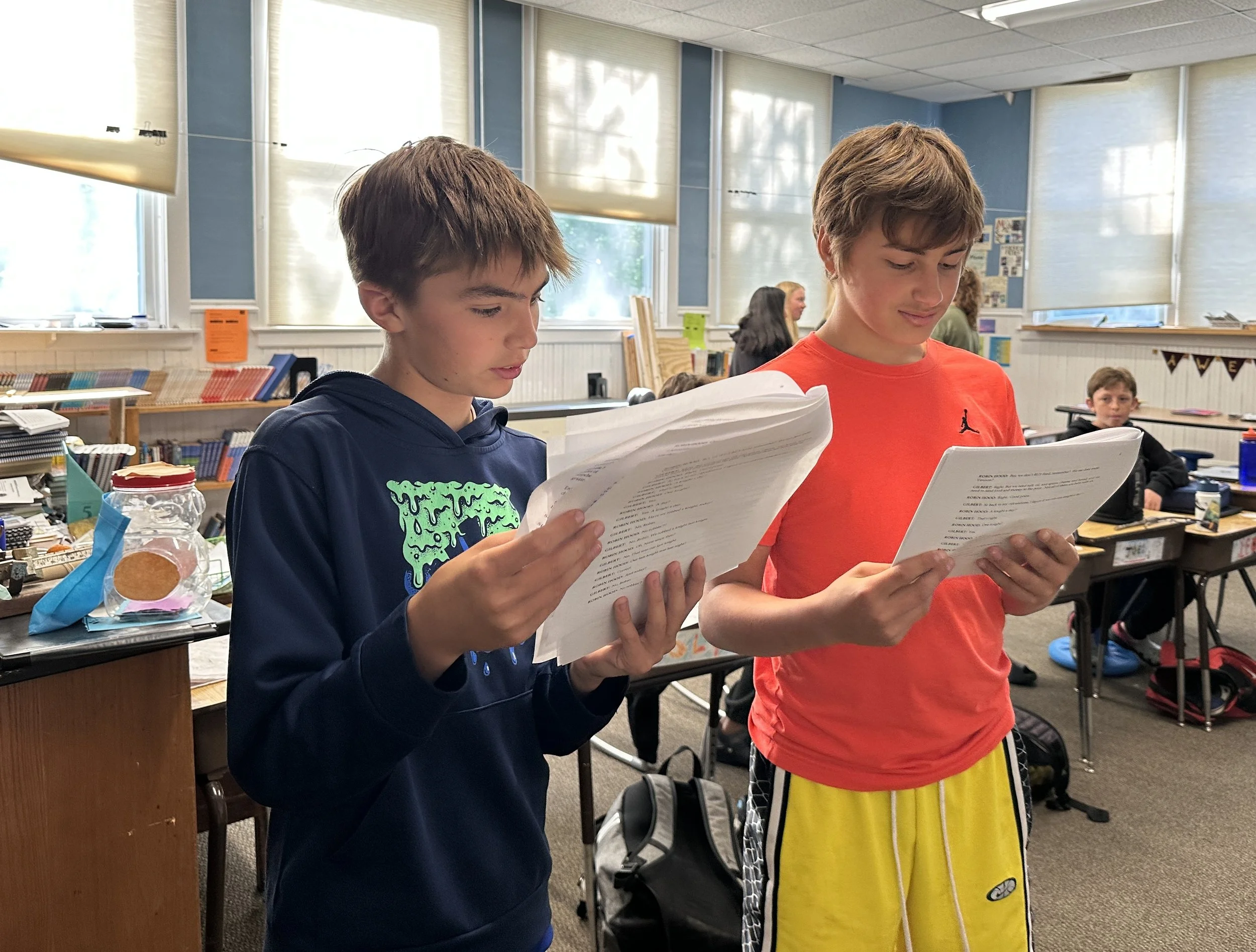
“Oh, my goodness, my class loved it. So, you see those trophies up there? They're wildly successful with it. But talk about a lot of agency and a lot of choice. If you're familiar with Odyssey of the Mind, it works similarly. Kids are given a challenge (instead of a problem). They have to figure out how to make it work. We had two teams. We had one team that made a game show called "Robots versus Humanity." Cry or die? And we had another team that did the structure problem "Above and Beyond". They did a lot of research with medieval history, and they had their set during that time period. It was very cool, and they loved that. Talk about the engineering process, though. Tons of failure. Oh my, it broke my heart, all the failure, but the resilience that came out of it.
And, yeah, and they did quite well. They wanted to stay in from recess. They were so totally engaged. I just wanted to give a plug for that. I wanted to do it during the school day for the last 40 minutes of the day because I wanted to be sure that all of the kids kind of had to do it because if it was offered just as an after-school program, which it often is, then it gets watered down. So many kids do sports after school or just have other after school obligations that it's hard for them to join.”
“I'm very happy here. I'm not sure what the future of Woodbury School will necessarily be in our current political climate, but I'm here for as long as this school is here.”
Lindsey is in her element. She is happy teaching in rural Vermont, with her school, her students, colleagues, and now with her broader and connected community. The Woodbury Elementary School - and her students - are delighted to have Lindsey Benton as their teacher, as well!
